Trigger alert: contains autism and theological language
Let’s begin with the earnest adolescent Christian. Everything
was so utterly serious, the truth was a matter of more than life or death;
salvation or Dalmatian, with Cruella de Ville swishing her satanic furs around
the barren churchscape.
Enter the decidedly ‘small c’-charismatic preacher, whose wit often overstepped his theology and caused trouble. What a tour de force was Uncle Tom!
I didn’t understand him in the slightest.
But then (reader, thank Gxd I never married him! Despite my
teenage crush, there was an ocean of everyday things I didn’t understand – a
poor undiagnosed teenager with autism) who did I understand?
He gave me the nickname, so here I am: Truthless. Of course
he was teasing, but it took me several decades to learn what teasing was.
But Uncle Tom was uncannily prescient, because to be truthless
is the opposite of untruthful.
Mark C Taylor writes about the current theological landscape
in his phrase After God. He’s writing postmodern theology, what comes after the
death of Gxd which was announced in the 1960s. So here I am in this blog
posting an after.
I remember as a student being discomfited during a seminar
where the visiting professor looked over his glasses and said “you all know postmodernism’s
a joke, right?”
I get the joke now, after all those years, post haste.
Modernism in the early Twentieth Century was about the
novelist Henry James telling us to “make it new!” So the Twentieth Century did
make amazing new things, ripping up dog eared old hymn sheets: Cubism, Bauhaus,
Electronica, nuclear weapons. But in the moment of the new, the new is always
passing, unbearably, instantly lost. The point of the professor’s joke was that
we never get post-postmodern (that tired old other joke) because we have already
always been postmodern – always leaving what we have made, always saying
goodbye. I’m dying (“cancer, how awful, I don’t know what to say” etc.) but so
are you. Every cell of us. And that’s ok, how else can we keep changing and
growing without shedding our dead skin cells? Ashtrays to ashtrays – dust to
belated duster.
So a postmodern theology isn’t merely a moment in church
history (though already Neo-orthodoxy wants to eat it up and spit it out).
Something deeper, subtler – the kind of joke that might just make Gxd laugh. To
recognise that every glimpse we catch of Gxd – or of any thing, or word, or
meaning, for that matter – is always swept into another and another new. Or do
you think your dogma will save you from this perishing nuisance? Try
interpreting Scripture, a book, a play, the conversation you had with your
loved one five minutes ago – are you sure you’ve got the meaning right?
Might your understanding change in the light of something new (ah, you
snapped at me because someone cut in front of you in traffic … why didn’t you
say so? …)
And if you’re absolutely sure you’ve got it watertight, does
that let the water of baptism in at all; are you sure you’re not the one who’s
dead?
So when Mark C Taylor writes that we are perpetually After God,
it’s the paradox that the death of Gxd realised in us is also the life of
uncertain truth, which is alive in constant searching, growing, seeking After
God.
Apparently in some Buddhist schools, to be truthless is to
be the one fallen from the noble path, the lowest of the low. I’m happy (if
happy’s the right word) to follow that path which the apostle Paul learned to
take.
Truthless, of close, is close to ruthless by the skin of its
T. Relentless. Truth, the Spirit, doesn’t relent in leading us on.
“Come senators, congressmen, please hear the call,”wrote Bob Dylan in 1964, in The times they are a-changing.
I was a pre-schooler then, with years ahead before I’d understand his righteous sneer. Now I’ve reached the age where I see that in every generation the times need changing, because structural evil reinvents and revisits itself constantly, in the avatars of ego and power. And lest I point too self-righteous a finger, I’m just as immune to temptations of pride, greed or apathy as in fact we all are. Gxd forgive us if we sit on our even slightly dirty hands while evils rise, and we need to change and be changed.
So those words came to mind today as I read this article.
Eventually that madness of persecuting witches ended, replaced by (let’s not
delude ourselves) other forms of persecution. This Guardian article points out
that misogyny is not yet extinct, although in my lifetime it has been weakened
in what still to me seem unbelievable ways.
In High School there were four of us girls studying Physics. “So”, the
burly Physics teacher said, “we have girls in this class”; and proceeded
to hurl a textbook called Physics is Fun at us. Despite his attitude, it
was fun, which must surely have disconcerted him. If I might boast for a
second, I very naively raised my hand to point out his errors on the blackboard
and didn’t understand why he wasn’t grateful. Doctors and scientists, including
physicists, are no longer all men.
But my Physics
teacher had a point (“you’ll never be a diplomat,” my mother often smilingly
told me); my calling to be weird and different has undoubtedly caused me subtle
forms of persecution over the years, but I revel in its freedom just as, in all
likelihood, my witch sisters of the 17th Century did despite the
stigma.
Something more sinister about Bob Dylan’s sleazy congressmen
occurred to me today, however, in the labyrinth of language. It was often
reported in the transcripts still extant that witches confessed to having
“congress with the Devil,” or as we might summarise it, sex with Satan. This
seems a truly bizarre admission, when poisoning your neighbour’s cattle might
seem a more obvious form of black magic.
I can now see two explanations for these testimonies, perhaps. If a witchwoman is pregnant, who is the father? Misogyny would resist a need to blame men (even today it’s still prostitutes rather than their clients who are shamed by society). So a useful line of interrogation under torture would be the ingenious idea of blaming Satan, who of course is not one of us. Representations of Salem make that connection.
However, the second explanation which occurs to me is a double layer of evil. This second layer underneath persecution is an immeasurable tragic horror; what better language is there to describe rape and sexual abuse than being forced into sex with the devil him self? Perhaps my sisters weren’t ‘confessing to the crime,’ but in pitiful desperation, giving a victim statement. Which led all too terrifyingly to that other abuse of power which today we call victim blaming; as alive as ever, until the voices of we too are impossible to quench.
This strange relationship, what a novelist would call turbulent,
between religion and ruthless me, will never end until my dying day.
We sang our gospel songs when I was younger and I can only speak (or sing) for myself. For me, they were, in illo tempore (in that (questionably) sacred time), a kind of magic incantation which would bring down the presence of God into my brain and heart. Hand on that sad heart, it never did much except give my lungs and my love of melody a good workout. But the less it worked, the more important it was to try.
When Things Fell Apart, I did look Back in Anger – anger and
embarrassment, and utter scorn for those little rhyming cough sweets.
In a word, they were vapid.
But they just don’t go away. Here’s another one bubbling
up from my memory again:
‘This is the day … (desperate thrumming student guitars)
This is the day (effort to sing with gusto)
That the Lord has made,
That the Lord has made …’
[Well, d’uh. Who else made it? (unless you’re a sinful
Darwinist)]
‘We will rejoice (please let me)
We will rejoice (of course I am!)
And be glad in it
And be glad in it …’
[Rejoice? Be glad in? What century are we living in?]
Funny thing happens today. I wake up singing it in a Black Gospel choir, even my voice has an African timbre. Pure Ella Fitzgerald. And … oh Gxd, how funny you are! I actually really, really mean it.
The day as a gift. The decision to enjoy and savour it.
I’m not deluded. I won’t deny that there are many, many
times of
‘This is the day
that pure sh*t has made:
‘we feel a lot
Like slitting our wrists’
Or
‘we just can’t cope
With everyday things’
Or
‘we have a scream
Buried inside’
Someone will say oh, but Gxd’s with you, carrying you,
these are Footprints in the Sand days. Well, it sure as h*ll doesn’t feel that
way. Just feels like there goes another scummy waste of a day and so what if I
survived it.
But there are good days. More than good – I’d have to say
joy beyond words. Days when I can re-collect myself and re-connect.
These are the days
when I can write, and read, and stare at everyday beauty and smile. My collections
of paperweights and mineral crystals (no healing properties as far as I’m
aware, except exquisite beauty); the artworks on my walls; birds and trees
around and in my garden.
I’m sure William Stafford is describing these days often,
when he’s not in sombre activist mode.
Listen to him at his most joyfully connected, in Godiva
County, Montana:
‘We risk our eyes
every day; they celebrate, they dance
and flirt over this offered treasure.
“Be alive,” the land says. “Listen –
this is your time, your world, your pleasure.”
I’ve got a busy day ahead and I’ve just wasted ninety
minutes sitting writing.
But if I don’t write, everything else is really a waste
of time.
I will rejoice now washing dishes and taking the cat to
the vet and filing boring paperwork. And I feel pretty d*mn glad to be in it.
Imagine the sight in the dim light, a minister priest
deacon
With a silent sickle marking time and waiting for you
But that’s not what I mean, as T S Eliot’s Prufrock (in a frocked coat?) said, that is not what I meant at all.
I’ve been down that road, where anger consigns all ministers to James Hogg’s darkest caricature of Calvinism in his Confessions of a Justified Sinner.
No, at last I’ve learned to resist objectifying Gxd, self and other. No, no, I mean verb, not adjective.
This darkness is not the pitch black of Lucifer’s kingdom. Instead, it’s a poignant memory from the 1980s.
“Praise the Lord, all ye servants of the Lord –
Who minister within God’s house by night”
We used to sing that to a soft rock beat, and listen
endlessly to the CD by the Scottish singer Ian White, and it seemed full of a sacred
something.
It is, but back then religion was at best for me only two or three things; a sense of community, a virtual spiritual experience in the aesthetics of song, and a vaguely anguished longing for some sort of Gospel to be real in my life, instead of this pervasive feeling of Christian inadequacy. But I onward Christian soldiered on.
Of course it is indeed full of meaning that I didn’t then
see, because I wasn’t able to, but no matter, it was pretty much or maybe
almost good enough at the time.
It’s Psalm 134, in the archaic King James Version.
Now I see the meaning it holds for me at a deeper level,
the level able to ask itself, what does ministering by night mean?
The Catholic composer Olivier Messiaen stated that the
purpose of all his (huge) musical output was to glorify Gxd. However, when
asked if he felt a sense of sacred inspiration while composing, he replied that
he was far too busy working on the technicalities. As far as conscious connection
with Gxd went, he was writing in the dark.
This gives me enormous hope.
Often, I’ll slog and strain at work I believe to be
morally right, but I simply am too immersed in the task at hand to be consciously
pious. It gives me a vague sense of anxiety and shame that I’m not in constant
prayer, seeking guidance.
Saint Teresa of Àvila believed that doing the chores
was an act of prayer, and I know what she means when I feel that wellness of
creating order and sparkling cleanness in my house (which doesn’t happen often enough).
The act of washing the dishes, cleaning the windows, polishing the ornaments,
has a strangely meditative rhythm. So too can working on a factory assembly line,
a job I never despised.
But this is a different kind of ministry. This is the
kind of demanding, anxiety provoking work on the edge: giving a talk for
Extinction Rebellion, participating in a working group. Work where I’ve flung
myself in, usually to a deadline and feeling stretched to the edge of my social
and intellectual limits. The stillness of prayer feels light years away and
again, I’m soldiering on without that sense of Gxd which has only come to me by
a miracle in later life.
So I suppose in terms of conscious contact with Gxd I’m working
in the dark, just as Messiaen did, And yet he had the self-belief to say that
in his music there were moments which truly gave the hearer what he called a ‘breakthrough
to the beyond’: a glimpse of Gxd.
That assurance is what, in moments of stillness, I want
to evaluate. Has my work really achieved any glorifying of what in my best
moments I choose to call Gxd? In some moments, if my ego has stayed at bay,
perhaps yes.
But there’s more.
The Psalmist is telling me not only to minister by this
night, which takes a certain courage, but to do it “within His house.”
Surely I’ll also need to believe, as increasingly I do,
that the earth and every part of it is Gxd’s house, known by whatever name
there, or none.
The next sentence in this Psalm gives me even more hope.
“Lift up your hands, within the sanctuary,
And praise the Lord.”
This is not house, this is sanctuary; somewhere particularly
and specially holy.
It’s a stretch (the upward stretch of lifting of hands to Gxd in sun salutation?), as I’m reading this Psalm in English, not in Hebrew or Latin Vulgate, but this is how this version of the Psalm speaks to me.
I have permission, even in this dark apparent distance from Gxd, to lift my hands in joy of Gxd still there. The exercise (and this is work) might even do me good. I can assert that even in what seems the most outer space of my orbit, I’m still in that sanctuary.
If I remember that, much of my anxiety will melt away,
like a candle in the night.
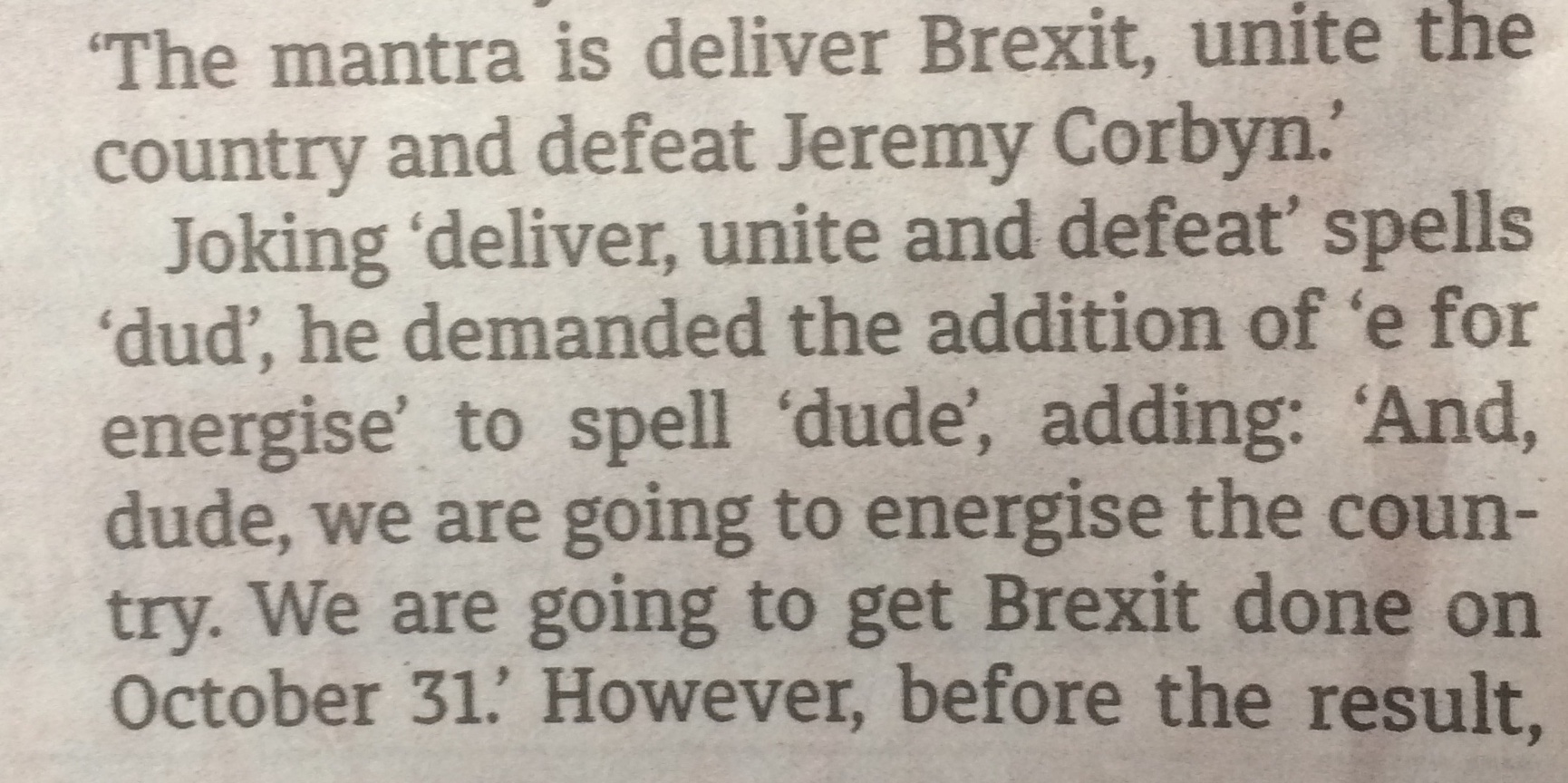
I can hardly imagine anyone less likely to say “dude” than Boris Johnson (except possibly the Queen or Jacob Rees-Mogg). His speech writers must have been on the phone to the White House to ask for some tips. Even so, it’s just never going to be easy for an old Etonian to take an American “dood” and bring himself to pronounce the syllables “dyoode.” But he’s certainly been other lessons from them, so why not this one too.