Featured

Good clean dirt

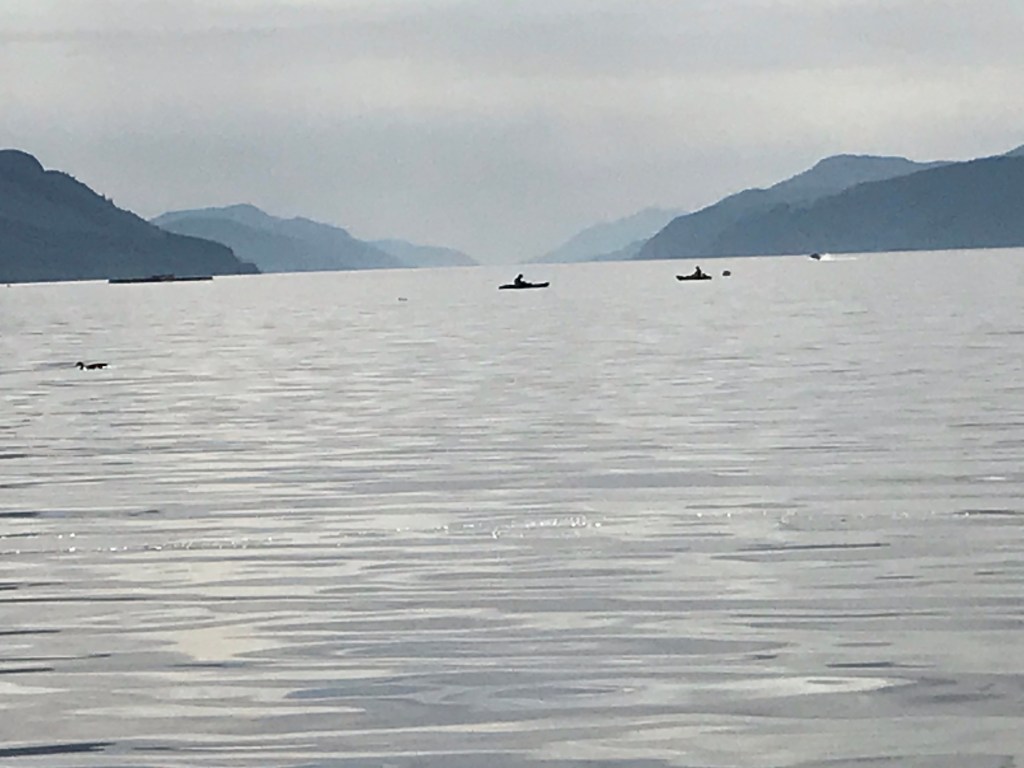
Loch Ness, September 2021

My great-grandfather worked with the horses out in the country. This was before factory farming and combine harvesters.

Ploughing, planting seeds and harvesting were hard and visceral, physical work, in all weathers and in the relentless seasons.

A family saying passed down from him is “good, clean dirt” – often humorous but for him a simple philosophy. To come home sweaty and dusty (or more often, it being Scotland, mud-caked) was an honourable sign of a good day’s work well done. I can imagine that to him, the stained shirt collar of an office worker might be an unclean dirt (how can you be tired after sitting at a desk all day, once asked Gran when I said I was tired).

Good clean dirt was the rich soil where food could grow; the stinking horse manure that could be good food for the vegetable plants once it was broken down and composted.

How long it’s taken me to understand good clean dirt. In Hebraic and Christian myth, we ourselves are made of that mucky malleable clay Gxd takes in her very hands to shape; in Islam, even muckier, it possibly seems to us, is our formation from a blood clot. In other words, before we are even expelled from the garden for our transgressions, even in the very moment of our creation, we are dirty – and this, I feel, is part of our human glory.

Antibiotic-resistant infections come about because of overuse to cure us too much; allergies because as babies we don’t develop tolerance; even our guts are screaming out to us that they don’t have a good enough selection of bugs.

How hard it has been for me to let go of the spiritual and literal assertion of the Victorians that “cleanliness is next to godliness.” We are altogether too clean; even our clothes are washed so excessively often that we waste water and electricity in the process of wearing them out prematurely.

Spiritually, then, are we meant to be dirty? I was educated in my church to be “godly” and “nice.” I don’t intend to be ungodly and nasty any more than I can help. But aren’t we nice Christians perhaps just a little secretly jealous of the loveable rogue, not to mention the younger brother whose father was so prodigal in welcoming back that profligate scoundrel?

My good friend Eilish often reminds me that without her faults and struggles she would be insufferably self-righteous.

Me, I don’t mind confessing that I have fallen in the mud a few times and may I never forget that. Now, as I put my toe back in the water of Christianity, already I feel that sterile temptation to be a little too cleanly again.

Yesterday I went to Dores beach on the edge of Loch Ness. It’s so stunningly beautiful it shocks me every time I return to it. The water is dark with peat – organic fragments washed down from the hills all along its length. Flecked with pieces of dead leaves and twigs. It’s a stony beach and underwater it’s hard not to lose your balance as you wade in. My brother is younger than me and he managed it no problem but I … I was scared of falling. I knew I could fall into a swim but the hardness of those stones kept me from going in any higher than my knees. And as anyone local knows, it gets very deep very quickly, very cold. But in the shallows it felt good.

The weather was so hot. The water was so beautifully cool. I wish I’d fallen into a swim and been baptised into that dirty water. Sometimes we have to take a chance and hope against hope that getting our hands just a teeny bit dirty might be exactly what She wanted us to do. Gxd knows, her son’s crucifixion was messy enough, bloody and sweaty to the point of horror. I only risked skinning my knees and smelling of peat, for the reward of swimming in the sun.


Why is Gxd Autistic?

Last week I promised I’d explain why Gxd is autistic (for why it’s Gxd instead of God, see last week’s blog! https://truthless.blog/2024/12/26/merry-x-mass/) It’s actually been a bit more than a week but time does speed up as I get older – that’s my excuse and here I stand, I can slither no other.

The short answer is that I discovered Gxd’s autism when I came to reckon with my own, some twenty years ago now. My friends from childhood describe me as eccentric, a little gauche … the psychologist described me in my 40s as a high functioning autistic woman. And so I began to scan theologies which resonate with me for traces of autism (theologies, not theologians). The results, even if they only scratch the surface, amazed me.

The Beatitudes, where Jesus called blessed those whom the world calls most wretched, have a topsy-turvy feel where my autistic heart feels safe to be as upside-down and different as I want to be.

I turned to a perhaps lesser-known work by the now less flavour-of-the-month researcher, Simon Baron Cohen for inspiration. In Zero Degrees of Empathy: a New Theory of Human Cruelty and Kindness (2011), Baron Cohen argues that there is a two-dimensional spectrum of human empathy. The variables are two contrasting types of empathy, namely cognitive empathy and affective empathy. Let’s say a friend is crying. With cognitive empathy, I understand why you are crying. With affective empathy, I care that you are crying.

Where this gets interesting is when Baron Cohen sees two opposing extremes in empathy possession. First, the psychopath, who has excellent cognitive empathy but little affective empathy – in other words, they understand why your friend is crying, but they don’t very much care. Second, however, is the autist – with scarce cognitive empathy they don’t understand why your friend is crying, but with abundant affective empathy, they certainly care.

Now I certainly recognise myself and other autists in that description. But Gxd? Surely, God is omniscient! God should have the ultimate cognitive empathy!

Well, I can only speak for myself. I am a huge fan of the Footprints story where Gxd tells the suffering and apparently abandoned traveler that “where you saw only one set of footprints in the sand, it was there that I carried you.” My own spiritual life with its share of both autism and trauma very often discerns only one set of footprints. It doesn’t feel as if Gxd was there at all. And yet I look back and see that I have, indeed, been carried – by what theologians like Tom Altizer would call an absent presence. So my Gxd, radically, is absent – to the point of impaired cognitive empathy.

My mother, Marnie Jack, ran a licensed grocer’s shop in a poorer part of town and gave the alcoholics a morning nip of sherry to stop the shakes, and who then went on to manage our town’s first ever Women’s Refuge. Mum had left the Church for her own reasons, but believed one thing passionately: “Gcd is love.” And those words are written on her gravestone, in fact.

My Gxd is total affective empathy – love itself. But Gxd’s absence feels a lot like Gxd has forgotten me in an act of impaired cognitive empathy. If this makes me a heretic, I’m in good company – Saint Teresa of Àvila and Saint John of the Cross were the two most famous examples of the spiritual experience of desolation and abandonment. John called it the Dark Night of the Soul. Without This strange strand of what is known as apophatic theology, “ordinary” or cataphatic theology on its own lacks the depth to face life’s tragedies and challenges, in my experience. I am glad Jeremiah wrote Lamentations and I am very glad we have the book of Job. I would have been crushed long ago without them.

In “The Autism of Gxd” I did my best to set out the case – maybe this blog explains a little of the why.

Merry x – mass!

King’s College, Aberdeen by Kit Dunster

Merry X-Mass!

In 2022 I wrote The Autism of Gxd – months later, imagine my irritation when Elon Musk stole my X! 

But back there before the world’s richest man purloined it, why did I write X – Not God but Gxd?

For a start, there were the negative reasons – for someone with a history like mine, living in a Christendom as we do, it seemed to me that the word “God” contained simply too much baggage – how to keep and yet let go of all that word’s power for good and ill? 

From somewhere, Gxd emerged – a paradoxical Gxd after God, rich with the theological heft of that then pure symbol, X. How many meanings of x can you trace? X the unknown of the equation; x marking the spot of buried treasure; x the kiss; x the chiasmic symbol chi, for those familiar with Greek; possibly my favourite, suggested to me during an open mic audience interaction, was x standing for ex-directory! 

And all these tropes are valid in Gxd. 

When I was in a certain rather rigid phase of evolution, I frowned upon “Xmas” because we should preserve Christ in “Christmas.”

Now I believe X is a fitting symbol for Christ crucified in our times and I want to reclaim it from its cynical (post-Twitter) anonymity. 

Merry Xmas (X – mass) to you in the cosmic and glorious autism of Gxd! Why autism? Ah, read on next week – or buy the book!

A Big Step …

Part of My Spiritual practice is daily offering of myself to Gxd, but if I’m honest, some days that feels difficult. Today was one such day, and I decided to probe why it can be so difficult.
It’s not that the existence of Gxd is in doubt – my empirical evidence, if you like, is simply the fruit of prayer. No, Gxd doesn’t give me the winning lottery numbers, and certainly doesn’t spare me from pain and distress. But Gxd somehow carries me through – and there have been so many key moments in my life I can only describe as miracle. Come to think of it, though, on a good day I will see the existence of every leaf of a beloved beech tree as a miracle, which is hardly good evidence likely to convince a sceptic! But so it is. I belong to a worldview where Gxd is. (I will discuss that word ‘Gxd’ next week – stay tuned, and have a think about what it might mean ….)
But somehow that doesn’t solve the problem. Some days I’m tired, I’m in a bad mood, I simply don’t trust anyone and that includes Gxd.
At this point, if I’m lucky (if you’ll pardon the expression), I will recall those ancient and archaic words which I was lucky to learn as a child: “I to the hills will lift mine eyes.”
Religion baffled me as a child, wondering what all those big words meant (and any success I have as a theologian depends on keeping open that bafflement which continues to question those big words).
But this line, as we sang the mysterious poetry of the Scottish Metrical Psalms, made sense to me. In the wonderful Highlands of Scotland, I lived surrounded by the majesty of sometimes even snow-topped hills; I knew what it was to gaze at them in wonder and have a sense of something bigger than myself.
And that’s exactly the point; I need something bigger than my Self, I need to re-affirm Gxd as the universal force of love, greater than hate, than self-dissatisfaction, than depression, anxiety, turmoil, exhaustion.
The delightful singer Marilyn Baker wrote:
“Rest in My Love
Relax in My Care”
and for me, the struggle is often to be able to envision that strong, universal love when I don’t feel it. But the hills speak to me of beauty and awe. I can remember that I, too, am part of this wonderful creation and am loved. In other words, yes, it is safe to offer myself to a Gxd who is love, not fear. From there, the psalm offers pure delight to my ragged spirit:

I to the hills will lift mine eyes,
from whence doth come mine aid.
My safety cometh from the Lord,
who heav’n and earth hath made.

‘Making’ is not a series of 24-hour creative projects, of course, but a mysterious and wonderful cosmic unfolding which science glimpses and celebrates in every journal article which advances our knowledge. My spiritual conviction is that yes, it’s fuelled by love – and hate will not win the day, however I might feel on a ragged day. My biggest setp is to keep that faith – so to the hills, I lift my eyes! I’m curious – where is your healing gaze?

White Water Rafting

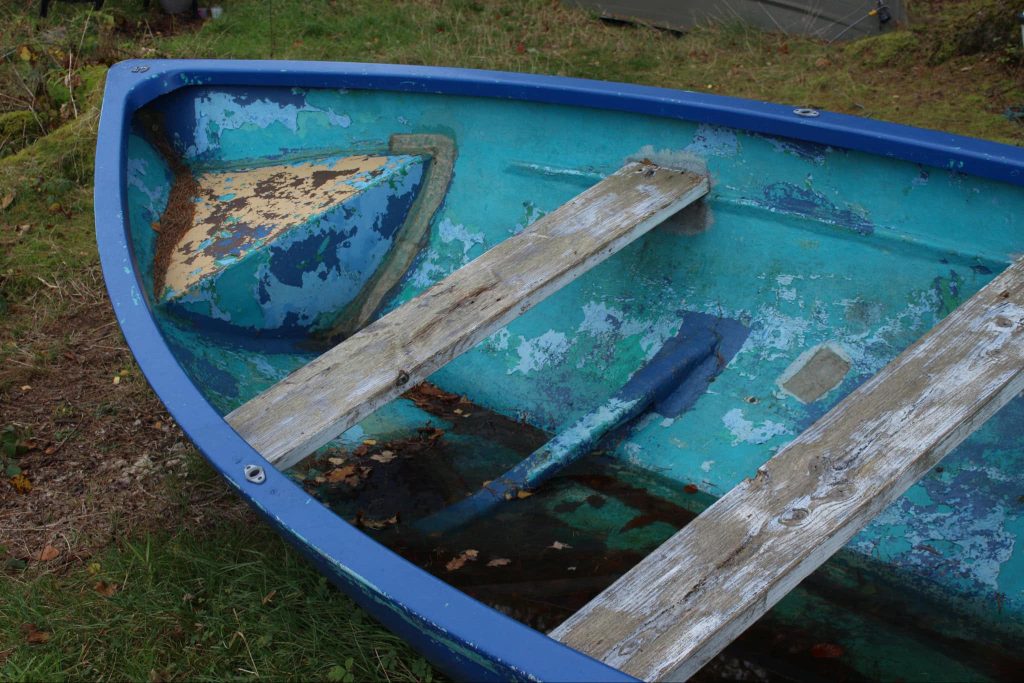
Yes, it’s a bonny blue boat (photo courtesy of Kit Dunster) but empty, beached, bleached, and rather dilapidated …

Since The Autism of Gxd (2022) I’ve been silent – writing plenty but not slowing down enough to reflect in here. So, rather than disclose all life’s vicissitudes and bore myself and you, I’ll sum it up like this.
At around age ten, my school class learned this jolly little song:
Row, row, row your boat
Gently down the stream;
Merrily, merrily, merrily, merrily,
Life is but a dream!
Even at age ten, this (then undiagnosed) autist found life a perplexing business, with an all too perplexing God at the apex. Imagine if it was all just a dream! and that (as Freddy Mercury would go on to sing) “Nothing really matters …” How I loved that song! I mean Row, row, row your boat (although who could not love Bohemian Rhapsody too). And how alluring Plato’s myth of the cave (Nick Cave!? – subject of another blog, another day … ;)) would be when I was introduced to it by my excellent Classical Studies teacher, a few years later (Please, please google Plato’s myth of the cave if you’re not familiar with it – let me know how it lands with you …). Merrily, merrily, merrily, merrily – life is but a dream …?
But soon after, as luck (or providence) would have it, a youth leader came to our church and took us teenagers away for a couple of wonderful weekends … of canoeing! Up in the lovely, safe, placid River Conon in Strathconon. Out on the water, I forgot my cares and my fears. Not for nothing do we attune ourselves so readily to the abundant symbolism of water in the Bible. I felt safe and free, weightless, almost, gliding along in my canoe.
But these weekends were to be only brief and short-lived oases.
Forty years on (Biblical symbolism allures again) and it comes to me how life is – well, it’s more like white water rafting. Which doesn’t suit me well, being such a very risk-averse and fearful soul. Twisting and turning, paddling furiously from side to side to avoid the next rock, carried downstream in foaming fast water beyond very much in the way of control … no thank you! But so it is. For me, at least.
But I don’t know … recently, with the support of my recovery friends, I’ve negotiated some of the rapids and come through with just a taste of exhilaration.

Who knows.
Maybe I’ll hoist a sail and glide into heaven yet!

The Book Launch!

Glasgow University Memorial Chapel, 3rd February 2023

Yes, launching your first book into the world is scary and induces all kinds of introspection and self-doubt – but when the day came, I could actually feel the Love in the room!

If you want to buy a copy, have a look here wipfandstock.com and use discount code autismofgxd (valid until 31st March 2023)

And if you feel led to leave me a review in YouTube comments I’ll be intrigued to read your thoughts!

more anon

Ruth

Throwing Stones and Taking Pelters

From Walls of the Cathedral of the Isles, Cumbrae

Throwing stones and having them thrown at you too … giving pelters and taking them too … that’s not either/or, but both/and. (For those not familiar with the Scots language, a pelter is something thrown at you, hard and painful).

Before I launch into discussing the Bible (which I will), let me make this clear. This is how I’m reading and what I think I’m reading. I think the Bible is a human document, full of errors, prejudices, tedious passages and legalistic attitudes. I think it’s a product of the cultures which it was written in; it’s frequently outdated, offensive and downright weird.

It’s also a book of stories of such astonishing wisdom and (I hate the word but there isn’t a better one) spiritual truth. So much so that that my verdict is that my Gxd seems to make a habit of speaking to me there. S/he seems to speak more clearly there (and more profoundly), than in any other literature or poetry. I don’t need to buy into the misogyny, homophobia, racism, imperialism, legalism and the impossible reversal of them all in Jesus’ ideal kingdom of heaven. All I do is read these stories and imagine what might be happening in them. I try to dig underneath the layers of pious/sentimental/legalistic readings we’ve probably all been exposed to. And there’s absolutely amazing stuff in there, if you look.

On that basis, the liturgical reading in my church today was a truly bizarre one. An old pastor from my childhood used to stop sometimes halfway through a sermon and say “you’re allowed to laugh, you know!” And this story makes me laugh – and see the truth, as all good humour does, by telling it slant.

Here’s the story. King David of Israel is riding through town with his retinue; think President Trump with the security detail , the Beast (the car, I mean …), the whole motorcade. Suddenly, a man called Shimei starts pelting the motorcade with stones, shouting at David and calling him a murderer. What happens next? Shoot to kill? That’s what David’s aides assume, but he tells them an astonishing thing: leave him alone – maybe God even told the guy to curse him.

The truth is, Shimei is right. Shimei is a relative of Saul’s, and David has, in fact, murdered Saul. I feel like Shimei. I want to throw stones and scream and curse at the so-called leaders who kill in my name; I didn’t back that war with Iraq, or the next one with Iran, or whatever, and on and on. I don’t want children barrel bombed in my name, because I know enough to know that every wounded child or bereaved mother and father is my sister or brother. David, you murderer. You killed my brother.

But here’s the thing. I also feel like David. “Maybe Shimei’s right; maybe he’s speaking God’s truth.” Because after all, he’s telling the truth; I am a murderer.

What? No I’m not! But I wonder. Last night I was completely scunnered (another Scots word, roughly meaning frustrated and p**sed off) because the speakers on my phone weren’t good enough to join a video call, and my headphones have snapped. Then suddenly, after I gave up on the call, I remembered how a child labourer worked in a mine, to dig out the cobalt for my phone’s battery. It’s not unlikely that, indirectly, by buying that phone I’m a child killer. You’re right, Shimei; you’re telling God’s truth. I probably am a murderer, one way or another.

Is that crazy and what can I do anyway? Sometimes I want to be a hermit in a cave and escape Civilisation completely – but I’m not brave enough or selfless enough. The activist and journalist Roberto Saviano says we are all complicit. So I’m David too.

Extinction Rebellion activists have an interesting take on this. They don’t blame and shame individuals (however tempting) but campaign against the toxic system which ensnares us all. So they seem to be taking a constructive way forward, which doesn’t throw any stones or condone violence at all (damage to property, possibly, but strictly not violence to humans and other animals).

To summarise Jesus, the most famous Biblical character of all, people who live in glass houses shouldn’t throw stones; and not to let ourselves off the hook and be inactive for change, but we shouldn’t even throw them at ourselves. Maybe use them instead – and not to build walls, but to build houses, schools and hospitals.

Life is a Cabaret … isn’t it?

My daughter Kit, who is both generous and astute, recently treated me to a wonderful show in the appropriately majestic His Majesty’s Theatre in Aberdeen.  It was John van Druten’s Cabaret, excellently directed by Rufus Norris.

If you’ve never seen this amazing musical, you really should. Think wild, extravagant liberty with an undercurrent of the ironic and the sinister.

I marvelled at the witty sheer audacity of the first act. It portrays a glorious debauchery in the pre-war German Weimar Republic; and the subtle undercurrent of comic yet slightly less glorious poverty by the landlady Fraulein Schneider. However the pantheon of utterly sexually liberated, wildly choreographed dance highlighted by actor John Partridge’s nightclub emcee is truly what stole the show.

Act Two skilfully led us in an apparent blink of the eye to the comic character Herr Schultz’s pathos as he tries to make light of the Kristallnacht pogrom, seen in the background broken window of his shop front. It’s all too easy to overlook how it’s followed by his invisible disappearance.

Of course all is revealed as the American ingenue Cliff Bradshaw is first beaten up by the Nazis for speaking out, and then pleads with the nightclub dancer Sally Bowles to flee Nazi Germany. Then the moment we have all been waiting for, as she captures the muted lightness of supreme irony: ‘Life is a Cabaret, old chum.’

Like Schultz, Sally Bowles is determined to believe that Fascism ‘will all blow over;’ she rejects Bradshaw’s proffered railway ticket out of Berlin.

The genius of Rufus Norren’s direction is to transform the liberated full and barely partial nudity of Act One. In Act Two this nudity is transformed into the tortured denudation of naked, huddled and cowed bodies behind a backlit screen, as we hear the gas of the Final Solution killing Jewish Germans.  And then the curtain falls.

But I’m struck by something even more deeply sinister than this, if that were possible. What I feel goes wrong in this production, and indeed the score itself,  is the curtain-call reprise of the eponymous Cabaret tune with utter zest by the orchestra; the hiss of the gas chambers has been drowned out by the show stopping Cabaret number, already consigning it to (our consciousness’) oblivion. Could a muted and ironic reprise accompany the encores? Surely not; the applause is duly celebrating the gloriously riotous choreography of Act One’s cabaret act.

Yet Kit and I were too shaken to join in the standing ovation (with the whole house clapping along in time):

“Life is a Cabaret, old chum

Come to the Cabaret …”

More than anything, there was a sense of fun as the audience filed out.

Is this a failure, and the betrayal upon betrayal enacted for and by the audience?

Who knows?

The unknowable and crucial question is this. How many people went home and asked themselves, wait, had they been duped by a Cabaret themselves? – what in Hell had they clapped along to? – how many thought a glimpse of something sinister for us ‘will all blow over’ – and how many went home thinking happily ‘yes, old chum’ – life is, after all,  let’s sing it, ‘Life is a Cabaret.’

And can we afford to think, right now or ever, that it is?

18 January 2020

The Other in HD

This will make me unpopular, but I’m truly not able to decide if Trump was right to assassinate General Qasem Soleimani last week. Was it a deliberate provocation to Iran, an arrogant Western meddling in the Middle East, or the legitimate defence of American lives in the region? Or even defending us from a threat of terrorism in the USA and Europe? I would really like to know; but I don’t, and I don’t think I’m going to be qualified to judge.

One thing I do know, and it’s come from an unexpected source – Facebook, the notorious home of Fake News – but this is only my reaction, which is definitely not fake.

For a while, after a long time of campaigning on Facebook, I was tired out and never wanted to see it again. It had seemed to eat into my precious time, and instead of a leisure activity it had become nothing but hard work. Now the campaign is over (we won! It paid off! But that’s a story for another day). After a rest from Facebook I’ve started to dip my toe in the water again. And a post from an American Iranian made me realise something fundamental to my attitude to the Other. In a sense it doesn’t even matter whether it’s ‘fake’ or not, although I can’t really see how it would in all probability be. But that’s not the issue.

The woman’s Facebook post was an album of about forty photos from around Iran. Other than the sheer beauty which overwhelmed me by these picture-postcard views from around the country, there were a number of things which struck me.

First, perhaps most obviously, the sheer wonder of intricate and complex historical architecture and art, both Islamic and Christian. What a feat of glorious design and gorgeous colours there was there. What a cultural and historic treasure.

Second, I was deeply struck by the vibrancy of contemporary sculpture and civil engineering; cutting edge, imaginative and daring, rather than backward and stale.

Third, women in headscarves but also looking pretty sharp in Western fashion – and clearly smiling and having fun as they strode down the street talking and laughing.

But the fourth thing, which might seem odd to select as the most impactful, was a number of scenic views of the mountains and forests. Yes, they were as lovely as the hills of my own country, but there was something strange which struck me.

Forests are places full of colour and natural ecological variety; and hills are not flat.

When I look at an unknown country on a map, all I see is a colourless two-dimensional shape on a piece of flat paper. And unconsciously, I perceive that unknown country (which I’ve never visited or read about) as equally flat and colourless. Now, I’m deeply thinking; may Gxd forgive me for (even unconsciously) seeing Iran as a stereotypical flat desert of primitive, lifeless people.

My point is that ignorance supports the process of dehumanising the Other, making it easier for us to bomb the villages and cities because we’re somehow not killing and maiming ‘real’ people.

Another, but this time quite funny example comes to mind. I love the unconscious humour of what I call Grammatical Malapropism, when an adjectival clause or an attribution is ambiguous and lends itself to ridiculous interpretation.

On BBC Radio Four (which I love) this morning, I heard an earnest reporter telling us that ‘we see melting glaciers on our tv screens.’ He’s right, and it’s absolutely serious, but something lateral in my brain made me laugh. I imagined hearing dripping water downstairs, and rushing downstairs to see an enormous glacier perched on top of my precious 58 inch HD television (that bit’s made up; my tv is small, old, and not HD – but you take my point). I imagined it slowly melting, and the water flowing into the electrics of the tv set. I could see a glacier melting onto my tv screen.

And that did something strange. Suddenly, melting glaciers weren’t just a distant image on my tv screen, but something which could be real.

In Iran, just as in the melting glaciers, there are real, three dimensional things and people beyond the images, and somehow it sunk in how very easy it is to pigeon-hole them as somehow less real, because less close to me. And, perhaps crucially, unknown to me.

I won’t quote Jesus asking me who is my neighbour (oops, I just did).

Instead, I want to ask how ignorant do I want to remain, to help me dehumanise the Other, and make nature and planet equally unreal in my emotional focus.

Is it possible for me to do the joyful work of knowing enough to rehumanise Iranian people, and to re-realise my world? No, not HD; 3D.

If you want some help, try watching BBC’s mini-series Ages and Ages. That’s all I’m saying.

Nets and Nests

First, the nets.

I watched the silver fish twist in torment as it died, I watched its red gills barbed into the tightly wound strings, and I knew this poor creature’s thrashing into final despair was my doing.

My family had to eat, I know, but for a moment a guilty compassion stole into me. But my family had to eat tomorrow as well as today. I wrenched the broken fish out, threw it in a basket, and got down to the prosaic end to a fishing trip; the untangling of heavy sodden nets. It made my saltened wet hands cut and blister, it made my tired senses rebel; it made my already overworked mind sigh inside. Pushing out another knot only to reveal another one; there was nothing poetic about it.

Let it go, said the bloke, uncannily unlike a Disney princess. Let it go. Leave the damn nets, come on, let’s get a pint and I’ll tell you my plan. Or something like that, if the gospel is to be believed.

It’s not the only liberation from nets I’ve come across.

Singing Psalm 127 alongside my soft rock hero Ian White in the 1980s I loved what seemed much more poetic; “Like a bird, like a bird out from the net – we have broken free, yes we have.” Being a young adult finding my place in the world, without fail I mispronounced it to call myself a bird broken free from the nest! – but there it is, deliverance for the bird, if not for the fish.

It occurs to me now how deeply Biblical, in fact, those nets (and nests) are. I went back to the nets over and over, unable to let those tangles go; they still ate into the tendrils of my salted, blistered soul. But I tried and tried, let it go, let it go, try and listen to the bloke’s plan. Not unlike the William Stafford Message to a Wanderer I posted in here a while back, I was attached to the nets and nests of my own imprisonment but freedom was always an occasional, surprising love, again and again. Surprised by Joy, as old C S Lewis put it; but not in a binary conversion. More in flickers and flashes between the greys of Scottish rainclouds.

How strange that ichthus, the fish, should die in the toils of the net, because the secret symbol of the hastily scribbled fish acronym (Iēsous Christos, Theou Yios, Sōtēr – Jesus Christ, God’s Son, Saviour) far predated images of the crucifix, much nearer to the primitive fish murderer I have been.

If the fish writhes in horrible death, the dove soars free of those nets.

And that sums a lot up pretty well; moments of participation in both Ichthus the butchered fish and, just often enough to save me, the dove descending with the lark ascending. While the nest of Fatherhood (and Motherhood) feels still unsafe to accept. For now. For now, I only see the dove between moments of being Tangled up in Blue.

I thought I’d ended there, but the skein continues. Tunes float into my head – that wonderful old Victorian sentimentalist George Matheson writing

O Love, that wilt not let me go,
I rest my weary soul in Thee;
I give Thee back the life I owe,
That in Thine ocean depths its flow

May richer, fuller be
O Light, that followest all my way,
I yield my flickering torch to Thee …

… and the Victorian poet Francis Thompson writing of The Hound of Heaven, Love pursuing us in perhaps too aggressive a metaphor – or not? Listen to the opening lines:

“I fled Him, down the nights and down the days;

I fled Him, down the arches of the years;

I fled Him, down the labyrinthine ways

   Of my own mind; and in the mist of tears

I hid from Him, and under running laughter.

            Up vistaed hopes I sped;

            And shot, precipitated,

Adown Titanic glooms of chasmèd fears,

From those strong Feet that followed, followed after.

           But with unhurrying chase,

           And unperturbéd pace,

       Deliberate speed, majestic instancy,

           They beat—and a Voice beat

           More instant than the Feet—

       “All things betray thee, who betrayest Me.”

And then the tender resolution of the poem:

Is my gloom, after all,

SHade of His hand, outstreatched carressingly?

Now into my mind is drifting the metrical Psalm 84:

Behold, the sparrow findeth out

An house wherein to rest;

The swallow also for herself

Hath purchased a nest;

Ev’n thine own altars where she safe

Her young ones forth may bring …

But where I will end is with a story I came across in Life of Pi today. I abhor all theodicies as a vile insult to the suffering and the needy. But I caught a glimpse of mercy for me in my tangled skein.

The holy man was inside the mouth of the god Vishnu, but when Vishnu yawned and opened his mouth he fell out. He saw all of the cosmos and infinite reality, and was terrified. So Vishnu picked him up and put him back in his mouth. Do I want to be swallowed by God, just as, in the Christian narrative, we swallow God in the sacrament? Do I leave my nets or do they leave me? Have I really  disowned enough restlessness to snuggle into that altar nest?  One day, I’ll know.